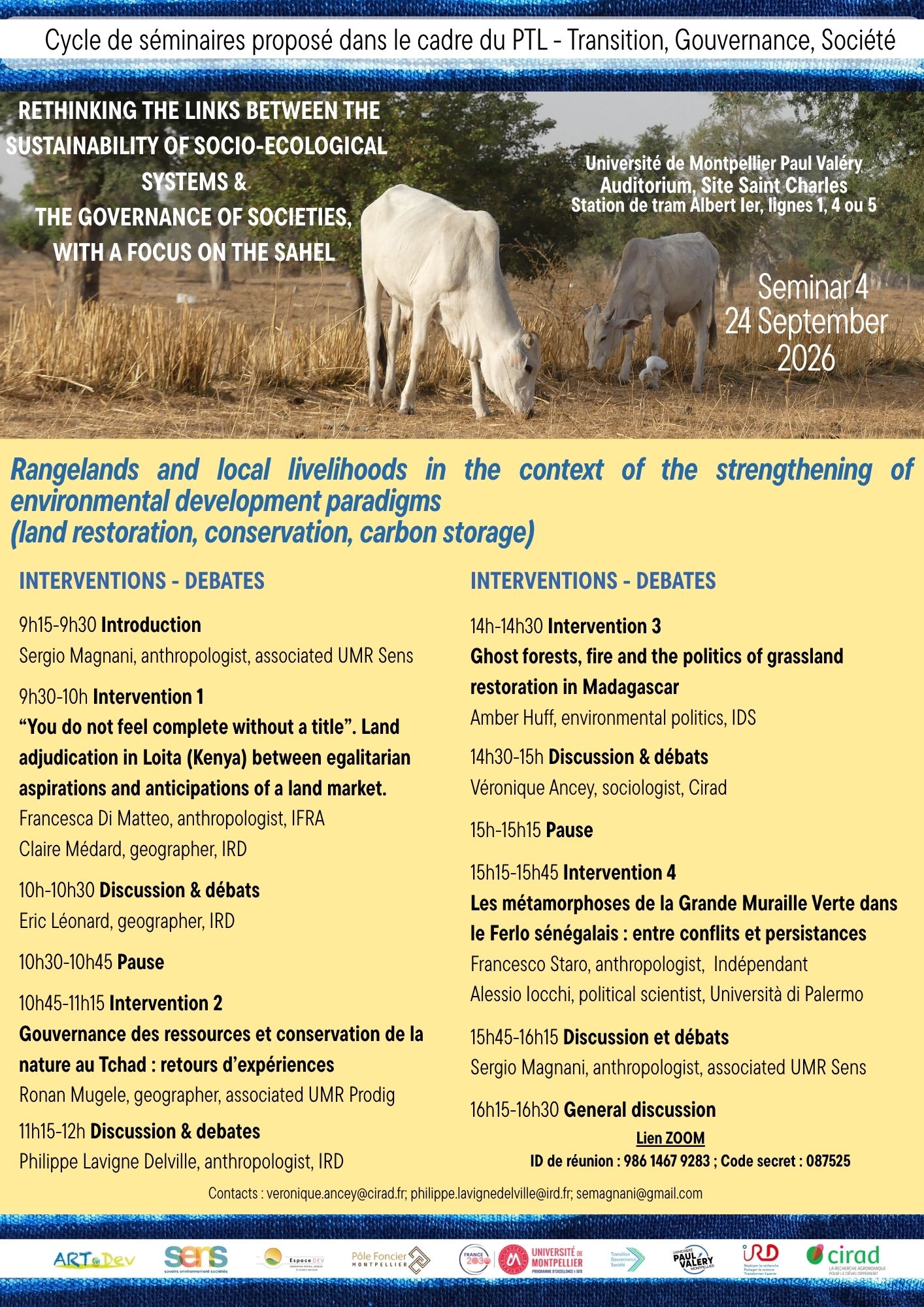

Repenser les liens entre gouvernance des sociétés et durabilité des socio-éco-systèmes à partir du Sahel – Séminaire 4
Après une longue période de dépréciation ou au mieux de « benign neglect », les terres de parcours et les livelihoods des populations qui les habitent, notamment le pastoralisme, sont aujourd’hui au cœur de nouveaux récits politiques qui intègrent les résultats scientifiques de manière valorisante, et assignent à ces milieux un rôle clé dans les objectifs de gouvernance inclusive et durabilité globales. Dans les faits, des recherches récentes montrent que cette nouvelle rhétorique globale promeut la financiarisation de l’infrastructure développementaliste. Celle-ci qui impose de nouvelles formes de gouvernance foncière et des ressources, au prix d’une nouvelle accélération dans l’accaparement/dépossession des terres, la concentration des moyens de vie, la fragmentation des territoires et des systèmes socio-écologiques. De telle manière, ces récits et ces dispositifs politiques théoriquement valorisants risquent d’aggraver les crises socio-environnementales et politiques qu’ils cherchent à résoudre.
Le 4ème séminaire du cycle réunira des travaux critiques qui analysent les modèles conceptuels et les rapports de pouvoir qui sous-tendent différents dispositifs de politique environnementale dans les zones arides (conservation, restauration, stockage carbon), ainsi que les divergences avec les perspectives et les systèmes culturels, productifs et politiques des populations qui y vivent.
Rangelands and local livelihoods in the context of the strengthening of environmental development paradigms (land restoration, conservation, carbon storage)
After decades of stigma or at best neglect, rangelands and local livelihoods, particularly pastoralism, are at the core of new policy narratives that integrate critical scientific findings in a positive light and assign to these environments and populations a key role in attending global objectives of inclusive governance and sustainability. However, recent research shows that this reframing is driven by the Financiarisation of the development infrastructure. The creation of new markets, investment and rent-seeking opportunities imposes new forms of land and resource governance, at the cost of a further acceleration in trends of land grabbing and dispossession, concentration of resources and means of life, territorial and socio-ecological fragmentation. In such a way, policy narratives and devices which theoretically value rangelands and local livelihoods risk to reinforce the very problematic socio-environmental and political crises it seeks to resolve.
The 4th seminar of the cycle will bring together critical studies that analyse the conceptual models and power relations underpinning the current strengthening of environmental and climate policy in rangeland environments. By discussing the politics of land restoration, conservation and carbon sequestration, the seminar will shed light on the discrepancies with the cultural, livelihood and political perspectives and systems of the people living there.
Voir la problématique détaillée du cycle
Programme
9 h 15 – 9 h 30 Introduction
9 h 30 10 h 30 : “You do not feel complete without a title”. Land adjudication in Loita between egalitarian aspirations and anticipations of a land market.
Francesca di Matteo, politologue IFRA // Claire Médard, géographe IRD.
Discutant : Eric Léonard, IRD.
10 h 30 – 10 h 45 Pause café
10 h 45 – 12 h : Gouvernance des ressources et conservation de la nature au Tchad : retours d’expériences
Ronan Mugele, géographe, Indépendant.
Discutant : Philippe Lavigne Delville, IRD.
12 h – 14 h : Pause déjeuner
14 h -15 h Ghost forests, fire and the politics of grassland restoration in Madagascar
Amber Huff, project « Repair » IDS, narratives of rangeland restoration
Discutante : Véronique Ancey, CIRAD.
15 h 15 h 15 ; Pause
15 h 15 – 16 h 15 : Les métamorphoses de la Grande Muraille Verte dans le Ferlo sénégalais : entre conflits et persistances
Francesco Staro, anthropologue, Indépendant // Alessio Iocchi, politiste, Université Palerme.
Discutant : Sergio Magnani, Sens.
16 h 15 – 16 h 45 : Discussion générale et clôture